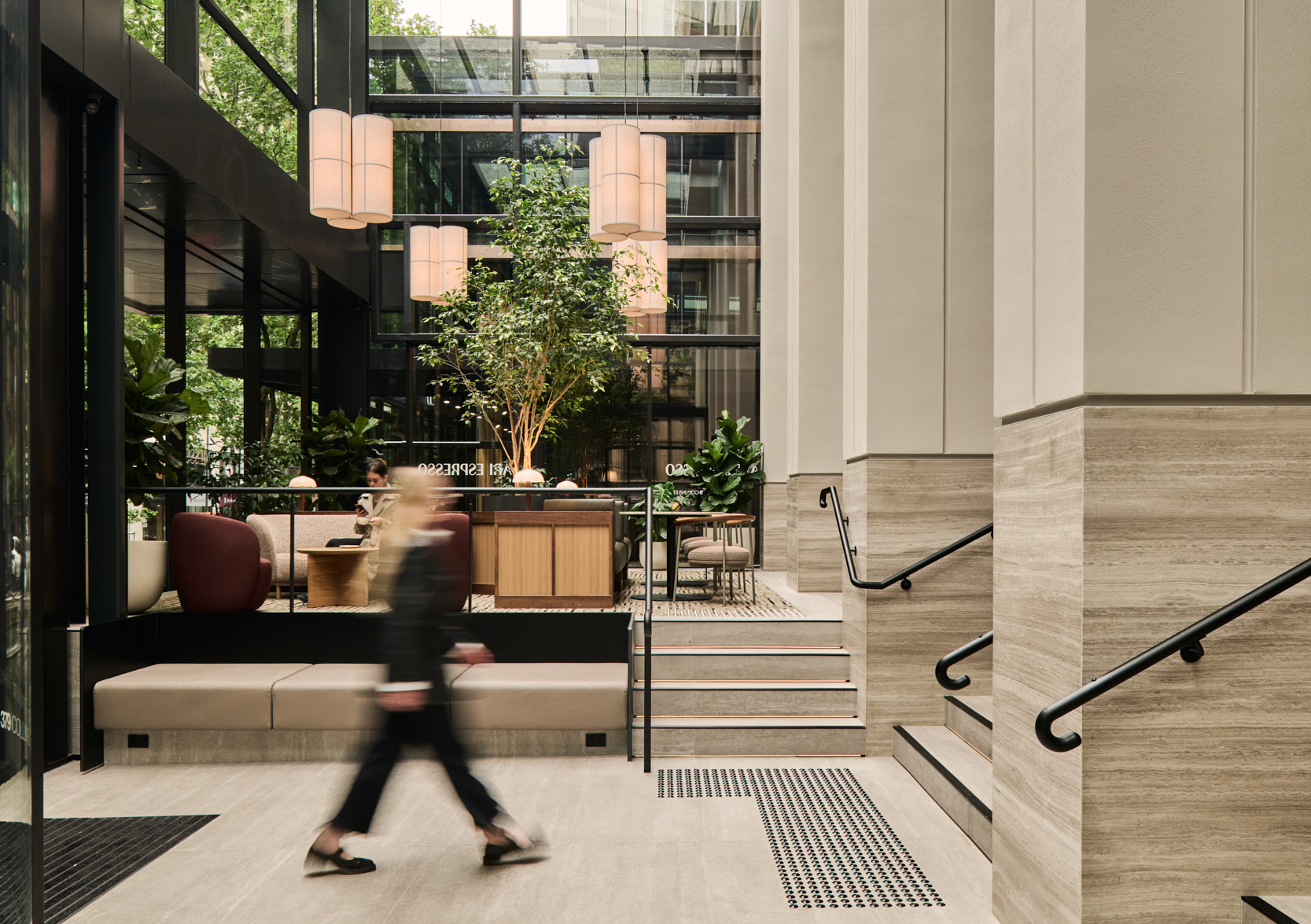
At Riverlee, we believe the built environment should do more than provide a place to work. It should support wellbeing, connection and everyday experience. One of the ways we bring this philosophy to life is through the integration of biophilic design across our workplaces and shared environments.
Modern workplaces are often defined by glass, steel, artificial lighting and screens. While these environments enable productivity, they can also feel disconnected from the natural environments humans are instinctively drawn to. Biophilic design responds to this challenge by reintroducing natural elements into the built environment — creating spaces that feel alive, inviting and worth spending time in.
What biophilic design means
Biophilic design is an approach to architecture and interior design that strengthens the connection between people and nature. Grounded in the understanding that humans have an innate relationship with the natural world, it incorporates greenery, natural materials, light, airflow and organic forms into built environments.
For Riverlee, the concept goes beyond decorative greenery. As Gabriel Kok, Design Director at Riverlee explains, “Biophilic design is such a broad word. Most people think it’s about putting in a lot of plants – that’s not what you want to achieve.”
Instead, the focus is on authenticity and environments where nature can exist naturally within the built form. “We represent nature as nature, not as an art piece,” Gabriel says.
Embedding biophilic thinking from the outset
As part of its commitment to fostering workplace environments and stronger building communities, Riverlee places a high priority on biophilic design. This approach begins early in the design process, with in-house teams and specialist consultants working together to embed natural elements from project inception.
“In most projects, there will always be an element of biophilia — it’s just how far do we scale it,” Gabriel explains. “Any area we control, we’ll always have a plan to introduce landscaping.”
Beyond the lobby
Ground floor lobbies often provide the most visible expression of biophilic design. Across our properties including 379 Collins Street, 179 Queen Street, 369 Royal Parade, Melbourne and Max Angus House, Hobart natural materials, planting and carefully considered spatial elements have been integrated into arrival spaces to soften urban environments and create richer, more welcoming experiences.
Studio Tate’s Alex Hopkins, who led the interiors transformation at 379 Collins St, sees this approach as both principled and precise. “Riverlee’s approach to biophilic design is inherently holistic, but defined by a considered restraint in its execution. There is a clear focus on tenant experience first, allowing nature to inform the architecture without over-designing the outcome. The lobby is less a point of entry and more a moment of recalibration. Natural light, scaled planting and softer spatial cues work together to support circadian rhythm and create a quieter, more considered arrival, one that carries through into the daily experience of the building.”
At 379 Collins Street, the lobby planting installation draws inspiration from Melbourne’s leafy streets. “When you walk along Melbourne streetscapes, the tree canopy creates this dappled lighting effect. That’s the kind of richness we want to bring into the building,” Gabriel explains.
At Max Angus House, the design centres around Tasmania’s largest indoor rubber tree that acts as a natural focal point. “Every building needs some form of magnet… and we designed around it,” he says.
Biophilic thinking also extends into communal areas and meeting spaces across Riverlee developments, helping shape environments that people naturally want to spend time in.
While biophilic design is sometimes associated with sustainability outcomes, Riverlee sees its greatest value in the amenity and activation it brings to buildings.
“Biophilia doesn’t contribute to sustainability as such… it’s about amenity,” Gabriel says. “When you create a space that feels warm and fuzzy, it attracts people.”
Active environments encourage connection and interaction. “A lobby packed with people versus one clad in stone but empty — that’s where the value creation is,” he explains.
Supporting long-term value
Biophilic design also supports long-term asset performance by creating environments people want to spend their time. Maintenance is considered early in the design process, with landscaping budgets and operational strategies factored into planning.
As Gabriel notes, “Sometimes you can’t be penny wise — you’re there to create an atmosphere.”
Designing places that support people
Biophilic design is a core principle of Riverlee’s broader philosophy of crafting considered places that foster human connection.
“If you create an environment that feels comfortable and blurs the line between indoor and outdoor, it encourages productivity. People will naturally stay longer in that environment,” Gabriel says.
Through considered biophilic design, buildings can create environments that feel grounded, human and connected to the rhythms of nature.
SHARE