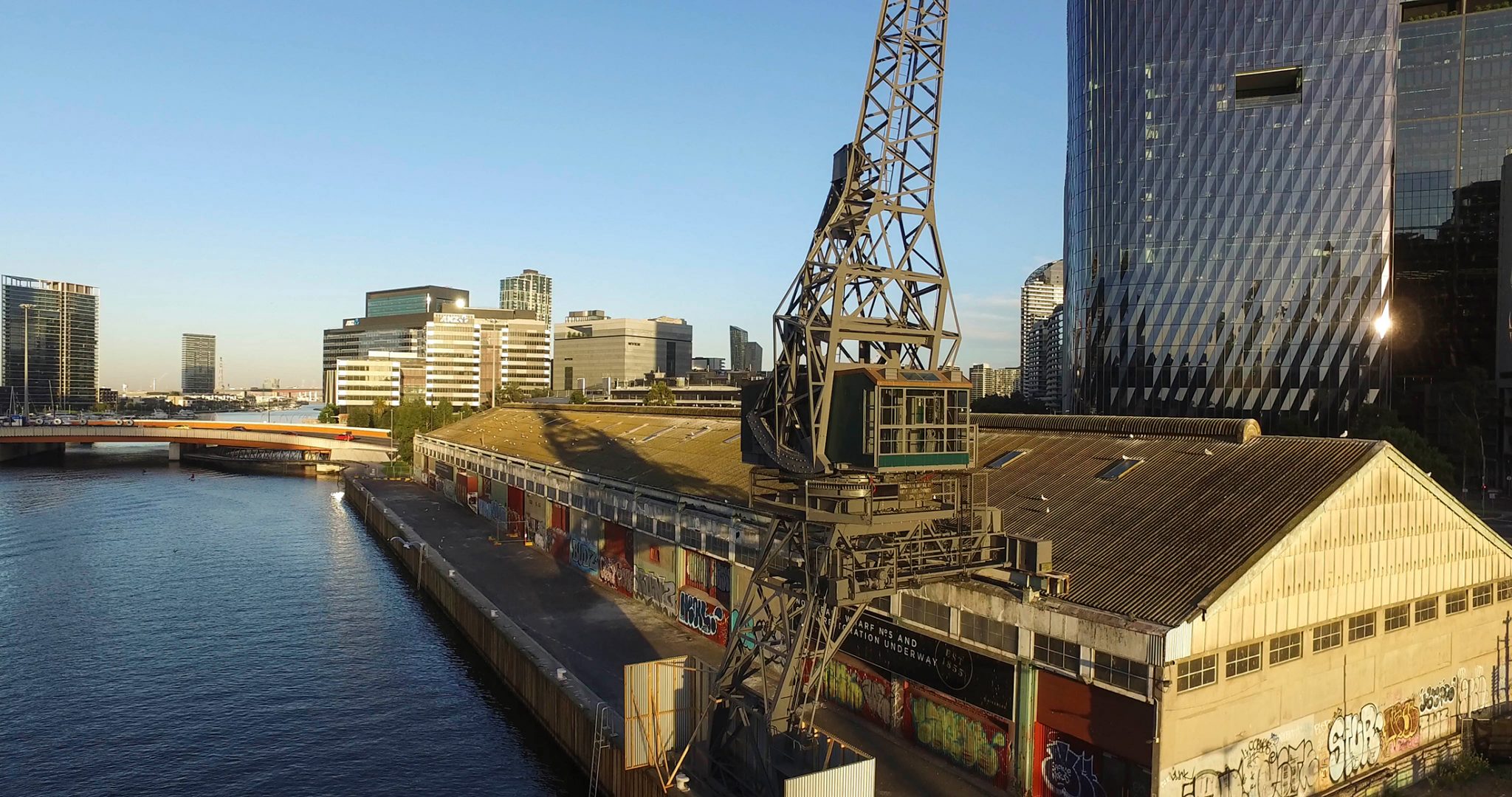
Melbourne’s last remaining original electric crane has been restored to its former glory and will act as a beacon for future residences, visitors and locals alike, finding a new home at the east end of the historic Goods Shed No.5.
The restored crane is a result of developer Riverlee’s commitment to the history and urban renewal of the site, with the Seafarers project set to revitalise the area along the Yarra River, paying homage to the site’s rich, unique history and industrial past.
Recognised in 2002 for its historical significance to Victoria, the Malcolm Moore crane was built in 1948 by Malcolm Moore Limited and is acknowledged as part of the most intact cargo berth in the Port of Melbourne from the pre-containerisation era, also known as Berth No.5.
Through additional investment and effort, Riverlee decided to relocate the restored crane from the west end of the history Goods Shed No.5 as a means of making it more publicly accessible, while integrating it with the forthcoming public park, Seafarers Rest.
Riverlee’s Development Director David Lee outlined that Riverlee is passionate about urban renewal and clarified that it was important that the mixed-use development was sympathetic to and cognisant of the wharf’s industrial past.
“We are excited to bring the rich history of the site back to life as much as possible and in particular, the restoration of the crane was so important to both Riverlee and the various partners involved,” he said.
As a collaboration between Maritime contractor Freyssinet and Lovell Chen, the crane has been carefully restored to ensure structural integrity. Detailed preservation methodology was set in place to ensure that any repair works undertaken were well considered and provided optimum preservation outcome for the heritage crane.
The restoration warmed the heart of original crane operator Archie Arceri, who thought it was a remarkable piece of technology back in the wharfies’ hay day.
The crane demonstrates what a lively area the wharf once was in the mid-1900s, and alludes to an analogous atmosphere that’s set to be emulated by the new Northbank precinct.
Riverlee looks forward to persisting in its mission to narrate the story of the site’s historical relevance, and will forever seek to reference its astonishing past throughout the Seafarers project.
Designed by renowned architect Fender Katsalidis and award-winning landscape designer Oculus, Seafarers will play host to 145 luxury residences, Australia’s first 1 Hotel, a 1,000-seat function centre, which will occupy part of the old Goods Shed No.5 and a 3,500 sqm public park.
The crane is viewable from the Seafarers Bridge, and construction on Seafarers is set to commence in 2020. You can watch Archie’s reaction to the restoration via the below 7 News Melbourne video